
Manufacturing / Heat Exchanger Manufacturers
Heat Exchanger Tender Analysis for Manufacturers
A heat exchanger tender states a duty, not a finished exchanger. Process and mechanical datasheets, the design code, inspection requirements and performance guarantees sit across the pack and have to be read before thermal design and pricing start. TenderGenie brings heat exchanger tender analysis to manufacturers, putting those requirements in one place with their sources, so engineering designs against checked information and the offer is prepared from it.
Five tools for your bids:Datasheet ExtractionFilled-in DatasheetEnquiry ChecklistKeywords ExtractionResponse Builder
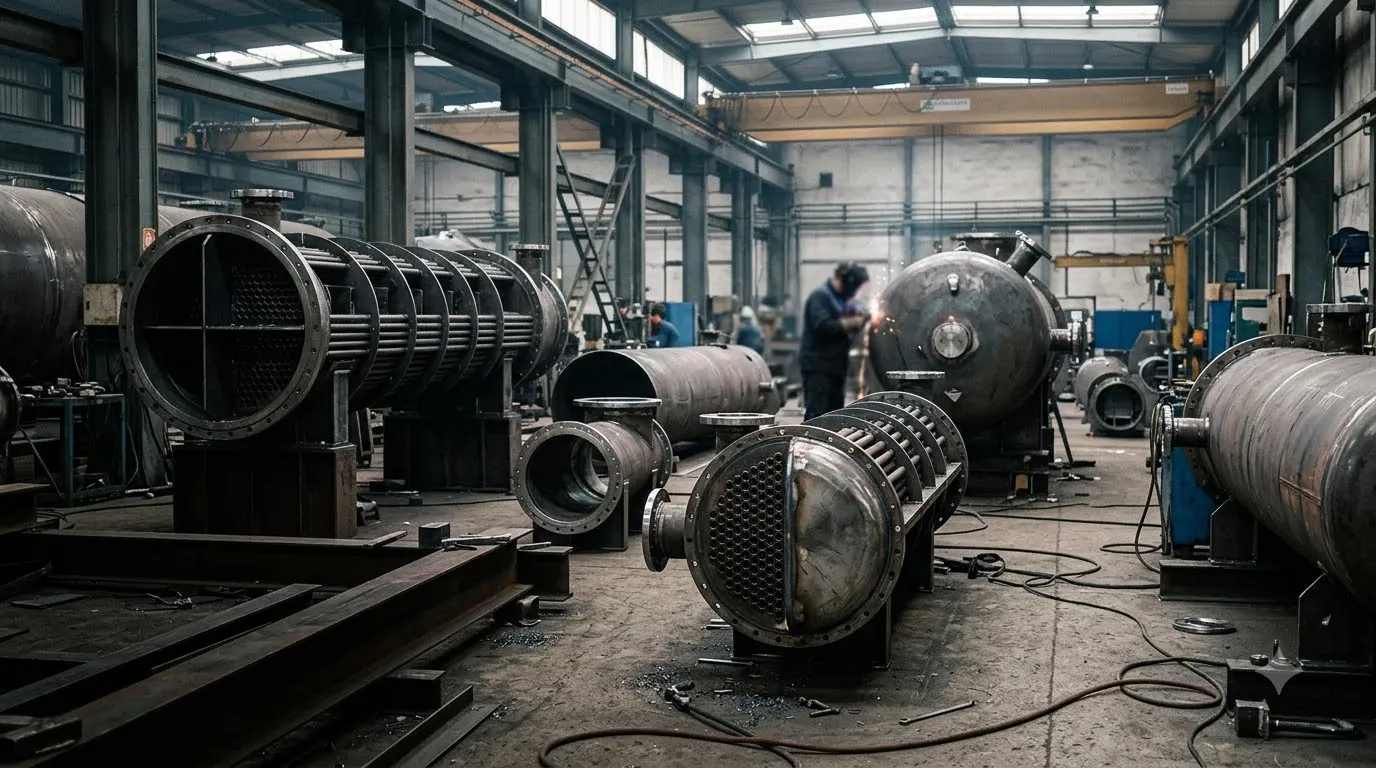

Tender challenges
A thermal duty, not a finished design.
Design comes before the price
Surface area, tube count, shell size and weight are only known once the exchanger has been sized, so engineering has to work through the datasheets before estimation can start.
Datasheet and specification disagree
A fouling factor, tube pitch, tube type or design margin on a datasheet can contradict the general specification, and each conflict needs a clarification or a stated assumption.
Code, stamp and inspection set the route
ASME, PED or IBR requirements, radiography, PWHT and witnessed hydrotests decide which shop can build the unit and how long it takes.
Guarantees outlast the offer
Duty and pressure drop guaranteed in the fouled condition, site performance tests and delivery liquidated damages stay with the company long after submission.
Five tools for manufacturers
From your catalogue to a complete offer for heat exchanger manufacturers.
One refinery shell-and-tube enquiry, followed through the five tools from your own design records to the compiled offer.
Datasheet Extraction
- The problem
- Product details are buried in long PDFs, from your own catalogues to the buyer's specifications. Copying values into a spreadsheet is slow and error-prone.
- What it does
- Reads those documents and pulls the key technical specifications out as organized data.
Your thermal design report, PDFIllustrative example Heat duty 2.4 MW Surface area 186 m² Shell side pressure drop 0.52 bar Overdesign 12% Tube material SA 179 seamless Filled-in Datasheet
- The problem
- Tenders ask for the buyer's own datasheet format with every specification filled in, which means copying and typing the same values again.
- What it does
- Fills the buyer's template with the data extracted from your product documents, so your team reviews instead of typing.
Buyer's TEMA specification sheetIllustrative example Transfer rate, fouled 412 W/m²K Pressure drop, calculated 0.52 bar Surface per shell 186 m² Tube material SA 179 seamless Filled for your review
Enquiry Checklist
- The problem
- A tender holds hundreds of requirements, certifications and conditions, and missing one can get a bid rejected.
- What it does
- Turns the buyer's requirements into a checklist of what to supply, what you meet and what is missing.
From the buyer's requirementsIllustrative example - ✓ASME U stampHave it
- ✓Five similar units in five yearsHave it
- →Thermal design summaryTo supply
- →Guarantee in fouled conditionTo supply
- !IBR approval for steam serviceMissing: needs a decision
Keywords Extraction
- The problem
- Telling what a tender is about, and whether it fits you, means reading all of it, and important terms still get missed.
- What it does
- Pulls out product types, standards, brands and deadlines, so you can filter, search and decide what to check first.
Refinery revamp tender, 180 pagesIllustrative example - ProductShell-and-tube exchanger
- ProductTube bundle
- StandardTEMA class R
- StandardAPI 660
- BrandApproved tube mills
- CommercialFouled condition guarantee
- DeadlineBids due 12 Jan
Response Builder
- The problem
- A submission is a set of documents: certificates, declarations, price schedules and annexures. Missing one can disqualify the bid.
- What it does
- Checks that every required document is included, fills in the annexures from your data and compiles one ready-to-submit package.
Documents the tender asks forIllustrative example - ✓Annexure A, company profileFilled in
- ✓TEMA sheets, one per tagFilled in
- ✓Compliance certificateFilled in
- ✓Guarantee scheduleAttached
- ✓Setting planAttached
- !Signed deviation listNot yet attached
Compiled in the order the buyer asked for
Read closely
Heat Exchanger Manufacturers: the tender, as TenderGenie reads it.
Move over the page: the lens shows the passages TenderGenie brings out, each with what it means for the bid. The excerpt is illustrative.
Section 4: Shell-and-tube exchangers (illustrative excerpt) found
4.1 The vendor shall be responsible for the thermal and mechanical design of each exchanger to meet the duty on the process datasheet for each tag number. Thermal design shall be carried out using HTRI or an equivalent program.
4.3 Exchangers shall be TEMA class R and designed to ASME Section VIII Division 1 with the U stamp. Exchangers in steam service shall comply with IBR where applicable.
4.5 Fouling resistances and allowable pressure drops shall be as stated on the datasheet. Where the datasheet and this specification differ, the more stringent requirement applies unless a deviation is declared with the offer.
4.8 Tubes shall be supplied with EN 10204 3.2 certificates. Each exchanger shall be hydrostatically tested in the presence of the purchaser's inspector.
6.2 The vendor shall guarantee the duty and pressure drop in the fouled condition. Delivery shall be within 36 weeks of the purchase order, with liquidated damages of 0.5% per week, capped at 10%.
What TenderGenie brings out
In the tender pack
What the datasheet commits you to.
Common items in heat exchanger tender packs, and what the bid team needs to check for each.
- Term 01
Process datasheet
Duty, flows, temperatures, fouling resistances and allowable pressure drop for each side. The basis of the thermal design, and of any performance guarantee.
- Term 02
TEMA type and class
The front head, shell and rear head designation and class R, C or B, which set construction requirements beyond the duty.
- Term 03
Design code and stamping
ASME Section VIII with the U stamp, PED or IBR where they apply. They decide who may fabricate and who must inspect.
- Term 04
Performance guarantee
What is guaranteed, in which condition, how it is proved in the shop or at site and what the supplier must do if a unit falls short.
The bid, start to finish
Five stages, applied to heat exchanger manufacturers.
Teams use the stages they need and revisit them as requirements become clearer.
Worked example: From a refinery exchanger enquiry to a clarified offer. Illustrative, not a customer case study.
Discover
Find tenders for the exchanger types you build, from shell-and-tube and plate units to air coolers and condensers, scored for relevance.
In the exampleA heat exchanger manufacturer finds a refinery enquiry for shell-and-tube coolers and a kettle reboiler.
Tender SourcingUnderstand
Extract process and mechanical datasheet values for each tag, with the TEMA type and class, design code, inspection and document requirements and their sources.
In the exampleThe team uploads the specification, process and mechanical datasheets and the QAP, and extracts duty, fouling, allowable pressure drop, TEMA class and code requirements for each tag.
Document IntelligenceDecide
Compare stamping, past-supply and inspection requirements with what your shop holds, and flag datasheet conflicts, guarantees and delivery terms before design hours are committed.
In the exampleA fouling factor on one datasheet conflicts with the tube-pitch rule in the specification. It is flagged, a clarification is raised and the bid manager records a decision to bid on a stated assumption.
Risk & ComplianceExecute
Raise clarifications, assign thermal and mechanical review and compile the technical offer, deviation list and supporting documents.
In the exampleEngineers size the exchangers in their own design tools against the clarified data, while the Response Builder compiles the deviation list, code authorization and past-supply evidence.
CollaborationLearn
Record how each buyer answered clarifications and which deviations it accepted, ready for the next enquiry.
In the exampleThe buyer's answer on fouling and pitch is recorded against the customer for the next enquiry.
Enterprise Memory
Relevant capabilities
Where TenderGenie helps heat exchanger manufacturers most.
- Document IntelligenceMost relevantProcess and mechanical datasheets, the specification and its annexures are read as one pack, including cross-referenced and multivalued datasheets, with each value tied to its source.
- Risk & ComplianceMost relevantStamping, past-supply criteria, performance guarantees and delivery terms are reviewed before design effort is spent, with deviations to clarify noted against their clause.
- CollaborationMost relevantThermal, mechanical, estimation and commercial reviewers work from the same tender, with tasks, queries and approvals recorded in one workspace.
- Response BuilderAttaches code authorizations, past-supply evidence and forms from your organization documents and compiles the technical offer.
- Enterprise MemoryKeeps buyer-specific clarifications, accepted deviations and lessons for the next enquiry.
- Drawing & BOQ IntelligenceWhere GA drawings are part of the pack, BOM line items give engineering a structured list to check against the datasheets.
Questions
Heat Exchanger Manufacturers
questions answered.
Can TenderGenie fill in a buyer's TEMA datasheet?
Yes. Datasheet Extraction pulls values such as duty, surface area, pressure drop and tube material out of your design reports and the buyer's documents into a table. Filled-in Datasheet uses that data to complete the vendor fields of the buyer's specification sheet, for your thermal and mechanical engineers to review.
What does the enquiry checklist show for a heat exchanger tender?
It turns the buyer's requirements, certifications and conditions into a checklist of what to supply, what you already meet and what is missing, such as an approval for steam service. Missing items wait for your team's decision before design effort is spent.
What should a heat exchanger bid team check first in a tender?
The process datasheets for duty, flows, fouling and allowable pressure drop, then the mechanical datasheets, TEMA type and class, design code and stamping, inspection and certificate requirements, guarantees and delivery terms. Document Intelligence brings these together across the tender pack, each with a reference to its source.
Can it help find conflicts between a datasheet and the specification?
It helps the team see them. Document Intelligence ties each value to the document and page it came from, so a fouling factor on a datasheet can be read beside the specification clause on the same point, and Risk & Compliance notes where a clarification with the buyer may be needed. Engineers decide which requirement governs.
Can stamping and past-supply requirements be checked before we bid?
Yes. Risk & Compliance compares eligibility and TQ/PQ criteria, such as past supply to refineries or an ASME U stamp, with the credentials and documents your organization holds, and shows gaps before design effort is committed.
How do thermal and mechanical engineers work on the same tender?
In one workspace. Collaboration assigns tasks and questions to thermal, mechanical, estimation and commercial reviewers with due dates, keeps queries beside the requirement they concern and records approvals with an audit trail.
Does TenderGenie do thermal or mechanical design?
No. TenderGenie does not size exchangers, run thermal ratings or carry out mechanical design calculations, and it does not accept deviations on your behalf. Document Intelligence helps the team read the datasheets, specification and terms in context, so engineers design against checked requirements and decide each deviation themselves.
What does a heat exchanger bid team gain from TenderGenie?
Datasheet values for each tag in one place with their sources, conflicts and guarantee terms visible before design hours are spent, clarifications and reviews tracked in Collaboration and buyer-specific lessons kept in Enterprise Memory for the next enquiry.
Related solutions
Solutions for
heat exchanger manufacturers.
See it for your sector
See the workflow
for heat exchanger manufacturers.
Walk through TenderGenie using the kind of tender your team works on.